The World of the Aeshur
What does it mean?
In this world, life unfolds, beginning with the God races: the Ancients, the Bel-Aeshor, and the Aeshorim. These are the beings above all others, the architects of reality. Through their power, the planes of existence were divided, each claimed and sealed to preserve the balance of power among them.
Below them dwell the Saettrish, demigods who exist between the high and the low, bridges between realms divine and mortal. Beneath them, the Aeshur and the Bel-Or form the larger part of existence. The Aeshur are the mortal races, the peoples of the world, those whose stories are told. The Bel-Or, by contrast, are the wild things, the beasts and monsters that roam the land, untamed and ever-changing.
And so the name World of the Aeshur tells its truth, a world shaped by, and for, the mortal races. It is their lives, their fears, and their hopes that lie at the heart of the tales.
This world is not one of singular truth. It is layered with politics, bound by shifting alliances, animated by faiths both ancient and new, and fractured by countless interpretations of history. Though many agree on the rough outline of what came before, the meaning of those events varies wildly across cultures.
These differences are the very breath of this world. For it is not the questions we ask that define the World of the Aeshur, it is the countless possible answers they create.
What is it about?
The tales of the World of the Aeshur, and the heart of most stories told, center on a single, storied land: Valenya.
Though the world stretches across many continents, each holding its own myths, empires, and peoples, Valenya stands at the center of the mortal plane. It is here that history turns most sharply, where powers rise and fall, and where the fate of mortals is most often shaped.
To see the World of the Aeshur for what it is we must go through two parts. The first and smaller part, rooted in the past, and the other in the present. Together, they form the foundation from which your own story may grow.
The crafting of the realm
Formation of Valenya
Though Valenya takes center stage in the stories told, it is but a fragment of a much greater whole, a single land among many, scattered across a vast and deeply connected world. Other continents such as Tibraï, Laubicia, and the Unknown Lands stretch beyond its borders, behind the vast seas, each with their own legends and truths. Valenya may be central, but it is neither the only landmass, nor the largest.
Yet the world expands even further. Valenya rests upon the Aeshur Plane, the plane of the mortals, but this too is only the middle tier in a greater cosmic construct. Layered like veils atop one another, there are seven planes in total, with the Aeshur Plane resting at the center.
But the design of the Ancients grows wider still. These seven planes are not all that exist, together, they form a single realm, called Irion. This realm contains the planes and the life upon them, bound by shared laws and fate.
And even Irion is not alone.
There are seven realms in all. Each is a reflection of an element made manifest, a world shaped in the image of its core force. Irion, the center, is the balance, the realm of all elements combined. The others are purer, wilder and singular in essence.
To understand Valenya, then, is to understand its place not just in a continent or plane, but in a realm at the center of all that is known.
Created by the Aeshorim
As the Ancients originated the Bel-Aeshor, and the Bel-Aeshor created the Aeshorim, the first great cycle began, the cycle of life. From this sacred repeating event came all that would follow. Yet as the gates to the realms of the Ancients closed, their ever-uplifting presence faded from the central realm, and with it, the power of the Aeshorim waned.
Ages passed and in time the sons and the daughters of the immortals became mortal, the highborn faded into the low. But through their blood, the gift of the Ancients endured, flowing like a quiet river into the generations that followed. Now, tens of thousands of Solring later, the central plane belongs to the Aeshur, the collective of all the mortal races. On their plane, at its heart lies Valenya, the great and ancestral home to many of the mortal races.
The Aeshur spread across the world and walked many paths. But now, after all those ages the humans now stand as the most dominant force on Valenya. Yet close behind are the high elves and dwarves, who, together with the humans, hold the three seats of the High Council. Their position is not merely due to their numbers, but more so because of their immense contributions, the cities they raised, the trade routes they shaped, the armies they mustered, and the fragile order they helped maintain.
Still, these three are not alone. The orcs once held a place in the Council as well, but were cast out. Their legacy, marred by bloodshed and ruin, saw them deemed unworthy in the eyes of all but the orcs. And then there are the others: halflings, dragonborn, wood elves, dark elves, and tieflings, each bearing their own tale of origin, their own path across Valenya.
Beyond these, other races find home elsewhere. The genasi, aarakocra, tabaxi, triton, and goliaths dwell mainly upon the eastern continent of Tibraï. While the Aasimar, though sometimes found in Valenya, largely inhabit the far southern reaches of Laubicia, where they live alongside minotaurs, tortles, and many others of rare kind.
The Gift (Magic)
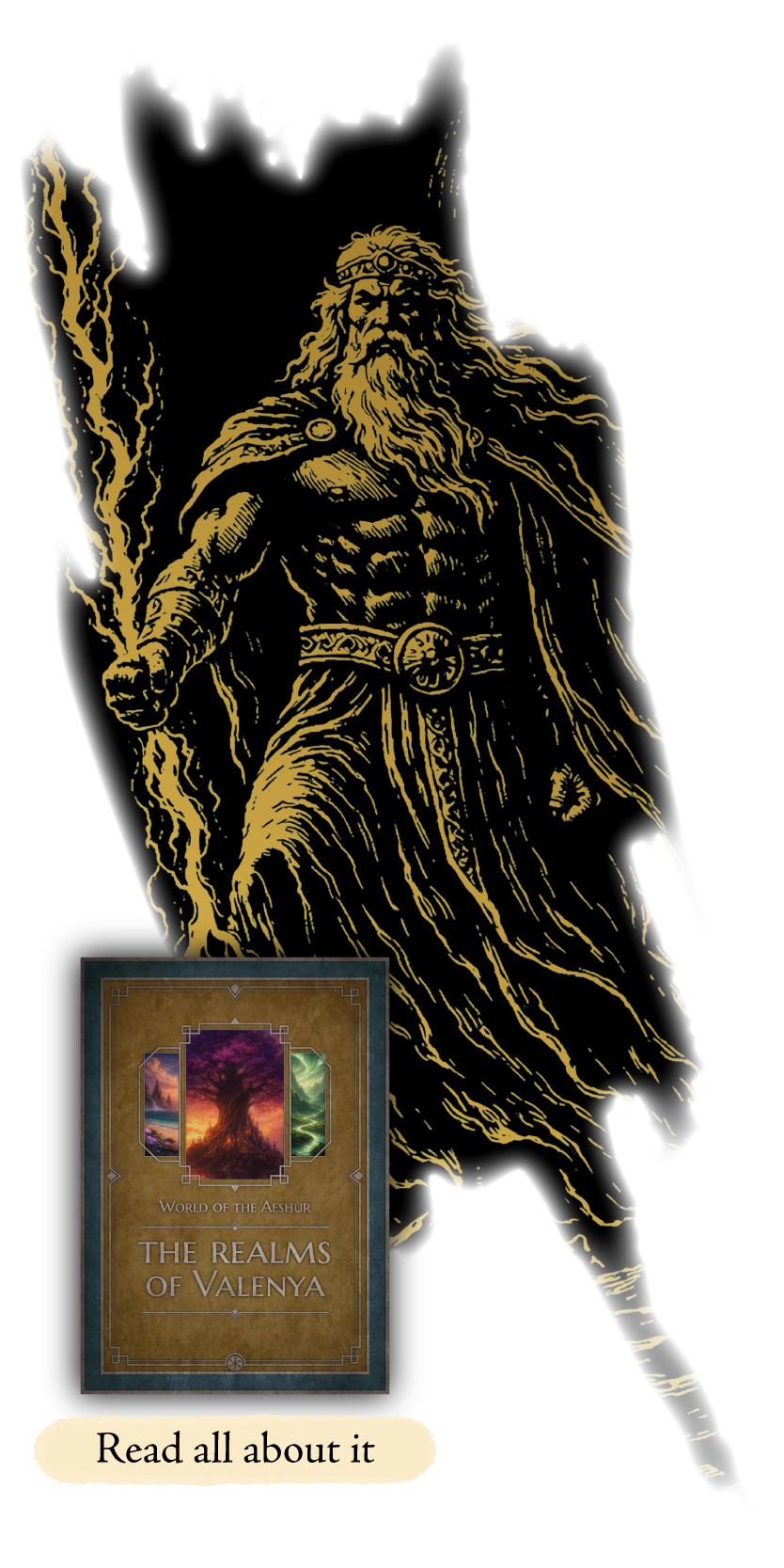
Once, in the dawn of creation, the Ancients alone wielded the power to shape reality with thought, a mastery the world would come to know as the art of magic. When the first of the Aeshorim arose, the Ancients bestowed upon them this sacred gift. And through them, the gift was sown into the blood of all who would follow.
But time flowed onward, and the mortal races claimed the lands while the Aeshorim went to their own plane. With the closing of the Ancients’ gates, the great rivers of magic slowed to a trickle. What once pulsed through the world like lifeblood became rare and thin. Now, the royal bloodlines, remnants of divinity, preserve that ancient spark. Rare, too rare, is the one born outside noble descent who bears the gift. And when such a soul appears, the world takes notice, for their worth rises as if touched by the heavens themselves.
Yet it was not always so. Once, the gift was a curse. A secret to be buried. In the dark age of the Dagonite Empire, the gift was seen not as wonder, but as threat. To protect his rule, the Emperor forged the Shaïkar, grim hunters cloaked in shadow, trained to seek out the gifted and erase them from the world. They brought silence to the song of magic, driving it to the furthest corners of Valenya.
But the world turned. The Dagonite Empire fell, and the Domerion rose from their ruin. Now, the gift is celebrated, a thing of beauty, of reverence. Yet still, it is hoarded. Most gifted souls dwell within the great Houses, their power shielded from the hands of the common folk. They wield the Ancients’ legacy not just in spell and flame, but as a divine right, a claim to the thrones of the Aeshur. For who, they ask, is more fit to rule than the children of the Aeshorim themselves?
The reality of the present
Valenya as of 314 A.D.
The current year is 314 After Domerian. To read the year, or Solring, is to already read about the truth of Valenya’s present: a world held in the firm grip of the Domerian Empire. Save for the scorched deserts of the South and the untamed Stormlands of the West, the Empire’s reach encompasses the heart of the continent.
But the Empire is no simple construct of ruler and ruled. It is a vast and intricate web of Houses, politicians, guilds, and the deeper cultural undercurrents that shape them. On the surface, its structure appears orderly, a High Council, within which the full Small Council holds a single vote. Yet each of these seats is claimed by the most powerful among their race, creating a game of quiet war: Houses and races maneuvering, scheming, positioning their own to ascend.
Each of the mortal races carries a history shaped by triumph and ruin, some through conquest, others through seclusion. Their views of the world are forged in these events through time. Yet despite their differences, all are bound to the will of the Empire. Each race holds its own domain, governed by its own laws and customs, but every voice must be heard in the Councils, every vote cast by chosen representatives. Their armies answer to the Empire's command, and their gold flows into its coffers, as dictated by the rule that binds them all.
This is how the Empire endures:
Through enforced unity, yet not at the cost of culture
Obedience is demanded, but customs are honored
Participation is required, but identities are preserved
Obedience is demanded, but customs are honored
Participation is required, but identities are preserved
62 - 01 - 314 A.D.
Houses of the Empire
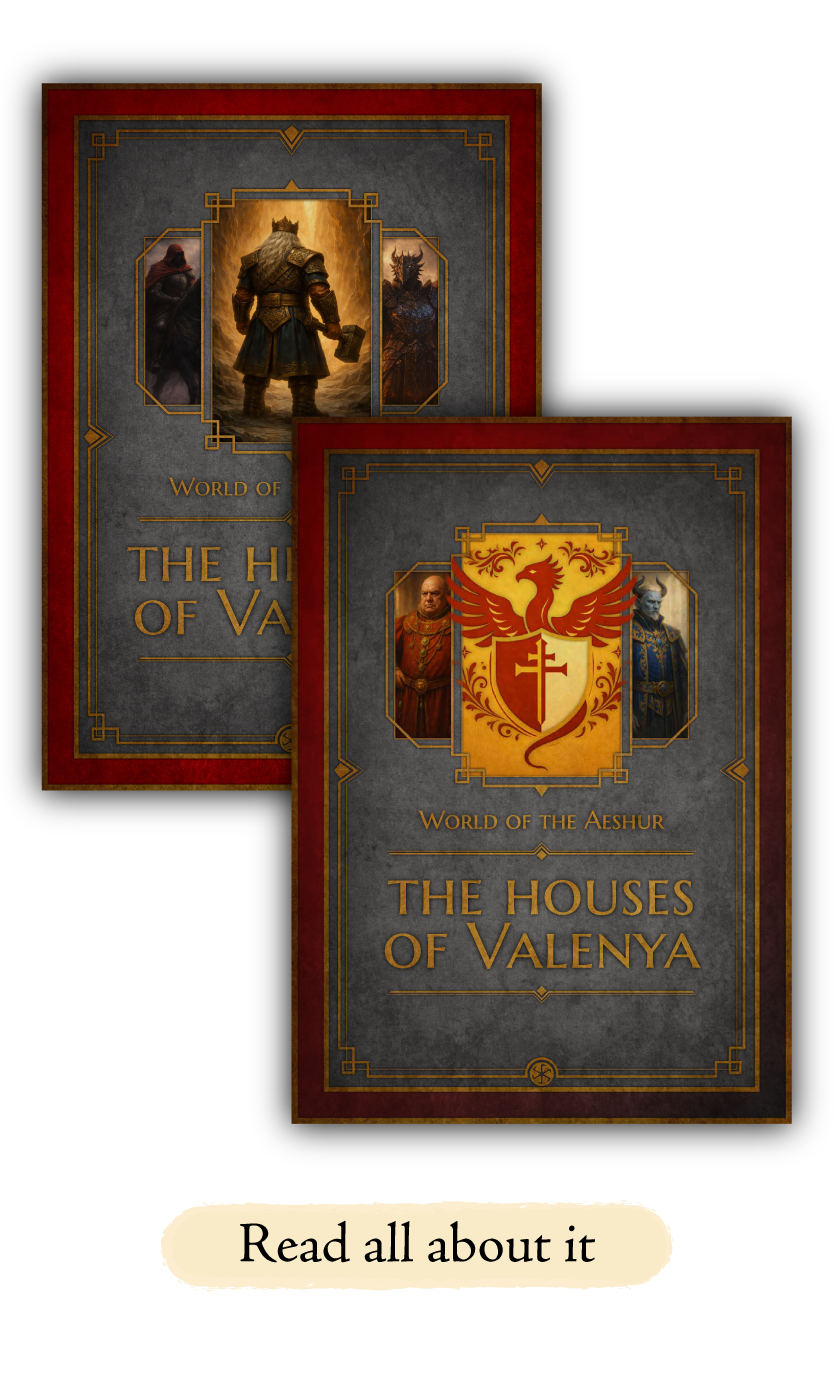
Beneath this grand web lies a shared thread, lineage. Across every race, over the course of ages, certain bloodlines rose in prominence. These became the Houses of the Empire, ancient or ambitious, noble or notorious. Some play their hand beneath cloaks of secrecy, others in the blazing sun of courtly pride. Some wield unseen influence across towns and borders, while others pledge their strength to the Empire's law, carving their path through allegiance rather than defiance.
Through the Empire, all noble Houses are arranged in strict ranks, rising or falling in status based on the influence they command. These ranks determine how much land, power, and control a House may wield across the realm. Above them all stands one singular and ever-dominant House: House Gudrunshild. For as long as the Empire has endured, they have reigned supreme, the greatest House in both name and deed, shaping the laws, wars, and legacy of the Empire.
Below them are the Great Houses, such as Dagon, Caster, and Raven. Only these Houses may hold seats in the Empire’s High Council, a privilege that grants their leaders the honored title of High Ones. These are the shapers of policy, the architects of empire-wide decisions, and often the quiet rulers behind the throne.
Beneath them lie the Major, Minor, and Small Houses. While these Houses lack access to the High Council, they form the backbone of regional power. And in the heart of the cities, scattered throughout Valenya, one finds the local Houses, smaller lineages who’ve risen through wealth or cunning to claim power in markets, streets, and guild halls. Though they hold little sway in the Empire’s grand game, their influence upon society and daily life is nothing short of vital.
And still, beneath the thrones and banners, it is not the Houses, but the guilds, that shape the board of the game. For they do not merely exist as entities, they define the culture that thrives on Valenya. Guilds forge the society, spark the chaos, and cast the long shadows in which power hides or rises. Whether forging alliances or turning blade against the ruling factions, each guild is a part in the making, and unmaking, of history.
The guilds and factions
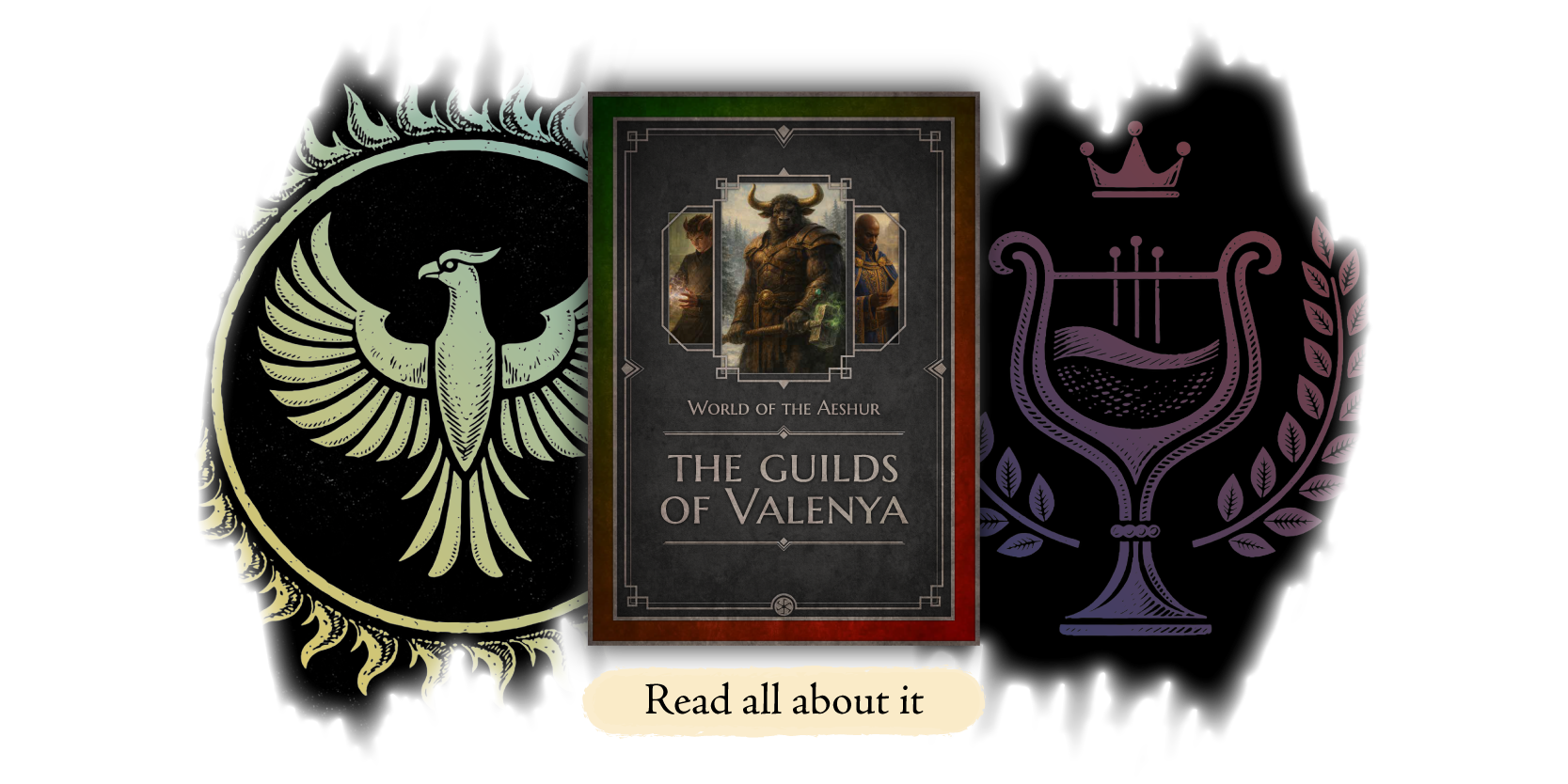
Where Houses and politicians shape the laws to which many are bound, it is the guilds to which culture bends. From the renowned First Talons who are the idols of the young, to the watchful Crimson Tree who care for the downtrodden, and the ever-dominant Black Order uplifting the gifted into a new age, each has carved its mark upon the face of society, shaping Valenya into what it is today.
For those who study Valenya and begin to trace the threads woven through its history, the vast influence of the guilds soon becomes undeniable. From economy to culture, from rulers to the Pantheon itself, the guilds are both source and vessel, channels through which the tides of power, belief, and ambition flow.
But not all guilds wield equal might. For at the heart of the Empire's enduring grip lies a sacred trinity, House Gudrunshild, the Black Order, and the Golden Lion’s Bank. Bound together in an alliance of influence, coin, and arcane power, this trinity has crafted the strongest foundation Valenya has ever known. To their shadow, many flock, drawn by promises of glory, wealth, or mere survival in a world that rewards ambition and punishes weakness.
Yet not all embrace this dominance. For beneath the weight of this unity, the common folk, the poor, the ungifted, the overlooked, often bear the heaviest burdens. From these margins rose guilds of resistance, forged not in greed or conquest, but in defiance and protection. Some formed to safeguard rights, others to reclaim dignity or simply carve a corner of comfort in a cold society.
Not all such guilds are held in esteem. The Crimson Tree and Golodh Nur, though dismissed by some as wild or uncivilized, remain fierce defenders of the voiceless. Still, none face the wrath of the Empire as deeply as the Eptir Myrkvah, the most hunted, feared, and misunderstood guild in all the land.
And then there are the uncaring, guilds like the Pact and the Qelloshar. They serve neither crown nor rebellion, choosing their own path through the turning of ages. These guilds exist within the Empire’s reach yet remain untouched by its rule. For politics only bind those who depend on the system or seek to oppose it. True freedom lies in being beyond both.
Starting a story in the world
Open endings
The core reason behind creating the World of the Aeshur was always simple, offering Dungeon Masters, Game Masters, and every TTRPG storyteller the foundation of a rich and living world, without the burden of building it all from scratch. This world was crafted to be vast yet open, deeply layered yet flexible, giving you the tools to shape something epic and personal. A place where your story becomes truly yours.
The current year is Solring 314 A.D. The Empire stands unshaken, its banners stretching wide across Valenya. Peace reigns on the surface, trade is thriving, the people prosper, and the legions remain unchallenged. But beneath that golden veneer, something stirs. You can feel it in the winds, hear it in hushed tavern whispers. Change is coming.
This is the year where everything begins to shift.
Every race, every guild, every noble House, and every city has a tension, an unsolved conflict, a hidden agenda, or a brewing storm just out of sight. If you’ve read through the books, you’ve seen the hints. Seeds of unrest, fragments of forgotten tales, unanswered questions, and these are not mistakes. They are invitations.
The World of the Aeshur was designed with open ends. Some are subtle, others more overt, but rarely is a cause laid bare. The true source of each tension remains deliberately obscure, giving you, the one guiding the story, the chance to decide what lies behind the curtain.
Take the Dwarven Domain in the north of Valenya: a realm teetering on the brink of civil war. The conflict between Loyalists and Traditionalists is mentioned on the map of this domain and in the race lore. But why are they truly at odds? Who is stirring the pot? Is it mere politics, or the return of Desifaüs, the Great Sinner? And if he returns… what then?
Or the elves. Their ruling House, the Ithilira, has fallen, replaced by the Kealor. You know their heirloom vanished, taking with it their rightful heir. But was it stolen? Were the Kealor involved? Is an external force manipulating them? Could someone be using this crisis as a distraction to breach Aïna Talar, their most sacred and guarded place?
Every thread in this world leads somewhere. But the destination is yours to choose. To explore the World of the Aeshur is to realize you stand on the cusp of change.
And from that change, your own legend begins.